Author: TEAM BHOLE ๐Ÿ™๐Ÿ™‡

  • The Great TDS Overhaul: Navigating the New Income Tax Act, 2025

    TDS on salary payments,
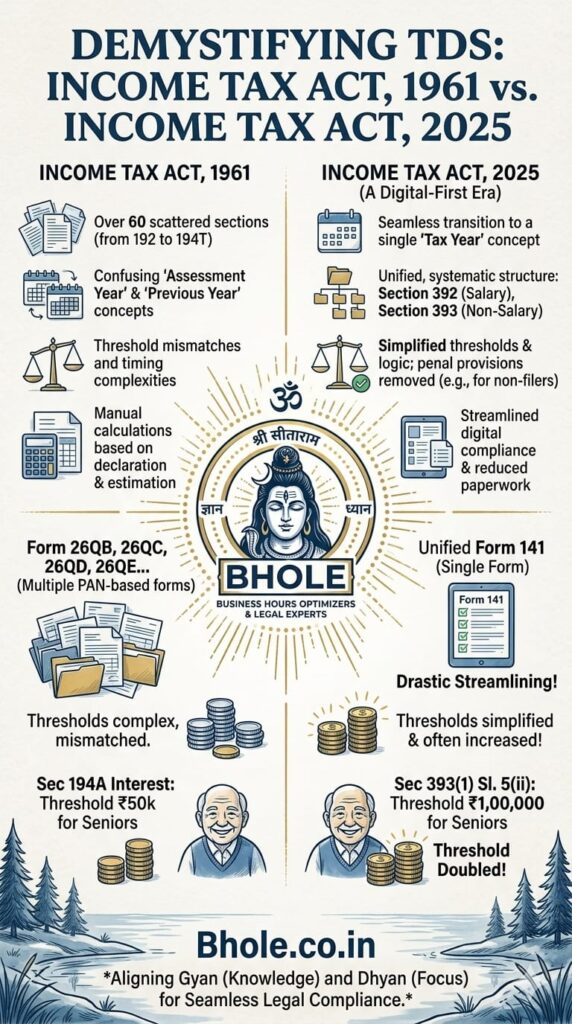
    Under the old Income Tax Act, 1961, the deduction of tax on salary was governed by Section 192. Employers were required to calculate the estimated tax liability of their employees and withhold tax accordingly. Under the new Income Tax Act, 2025, this provision has been seamlessly transitioned to Section 392. Specifically, Section 392(1) now serves as the direct equivalent to the old Section 192 for calculating and withholding tax on salary payouts based on the applicable slab rates. While the core calculation logic remains similar, classifying it correctly under Section 392(1) is now mandatory for all payroll compliance. Furthermore, premature withdrawals from the Provident Fund, which used to fall under Section 192A in the old law, are now precisely mapped to Section 392(7) of the new Act.

    TDS on Non-Salary Payments: The Great Consolidation
    The most dramatic and welcome reform in the 2025 Act is the creation of Section 393. Every single non-salary TDS provision that used to exist between Section 193 and Section 194T under the old 1961 Act has been absorbed into this one umbrella section. The new system uses a highly organized tabular format within the law itself, assigning serial numbers and numeric codes to specific transaction types, removing the need to memorize dozens of alphabetic sub-sections.

    Payments to Contractors and Sub-contractors
    Under the 1961 Act, businesses deducted 1% (for individuals and HUFs) or 2% (for others) on contractor payments under the heavily utilized Section 194C.
    In the 2025 Act, this exact requirement is now housed under Section 393(1), specifically located at Serial Number 6(i). A crucial substantive change here is the explicit, legally binding inclusion of manpower supply. Previously, there was genuine industry ambiguity regarding whether deploying contract workers constituted a “works contract” under old Section 194C. The 2025 Act unequivocally resolves this by classifying manpower supply services directly as “work” under Section 393. Therefore, businesses must strictly apply the 1% or 2% TDS to all labour supply contracts moving forward.

    Interest on Securities and Other Interest
    Interest on securities, previously governed by Section 193 of the 1961 Act, is now clearly located at Section 393(1), Serial Number 5(i) in the 2025 Act.
    More significantly, interest from banks and post officesโ€”famously governed by Section 194A under the old Actโ€”has moved to Section 393(1), Serial Number 5(ii). The new Act brings massive relief for senior citizens in this category: the threshold for TDS deduction on interest income for senior citizens has been doubled from โ‚น50,000 to โ‚น1,00,000 per Tax Year. For non-senior citizens, the threshold remains steady at โ‚น50,000. Furthermore, the new Act removes the timing mismatch for interest TDS, adopting a single-condition model where no TDS applies if total interest is under the threshold in a tax year, significantly reducing taxpayer hardship.

    Rent Payments
    Rental income compliance has also experienced a structural shift. Under the 1961 Act, Section 194I dictated a 2% TDS on plant and machinery, and a 10% TDS on land and building rent. Under the 2025 Act, this is governed strictly by Section 393(1), Serial Number 2(ii). A vital update in the 2025 Act is the expanded definition of rent. The new law explicitly includes factory buildings and land appurtenant to buildings within this definition. This means that individuals and HUFs are now clearly and undeniably liable for industrial rent TDS, closing a long-standing loophole.

    Professional and Technical Fees
    The highly debated Section 194J of the 1961 Act, which covered professional and technical services, has been seamlessly moved to Section 393(1), Serial Number 6(iii). A brilliant and much-needed clarification in the new Act’s definitions is that advertising is now definitively included under “professional services”. This entirely eliminates the old legal conflicts where businesses struggled to decide whether to apply Section 194H (commission) or Section 194J (professional fees) for advertising expenses.

    Cash Withdrawals
    Section 194N of the 1961 Act previously mandated TDS on large cash withdrawals. It was controversial because it included a harsh 5% penal rate and a much lower โ‚น20 lakh threshold specifically for taxpayers who had not filed their income tax returns for the preceding three years. The new Income Tax Act, 2025, operating under Section 393(10), Serial Number 5, has entirely removed these penal TDS provisions for non-filers. The punitive 5% rate and the lower โ‚น20 lakh threshold no longer exist, reflecting the government’s broader goal of reducing compliance friction and simplifying the tax architecture.

    Streamlined Compliance forms
    Previously, property buyers and individuals paying rent had to juggle multiple PAN-based forms, such as Form 26QB, 26QC, 26QD, and 26QE. Effective for the Tax Year 2026-27 onwards, the Income Tax Act, 2025 has consolidated all of these into a single, unified document known as Form 141. This single form now effortlessly covers property transfers, rent paid by individuals, and even transactions involving virtual digital assets under Section 393(1).

  • Tax Talk Refresh: The New “Vocabulary” of the Income Tax Act 2025

    1. Goodbye “Assessment Year,” Hello “Tax Year”

    For decades, we had to juggle two different years: the year we earned money and the “Assessment Year” when we paid taxes on it. It was confusing for everyone.

    The New Word: Tax Year.

    The Change: There is no more double-talk. From now on, you just have a “Tax Year” that aligns with the financial year. Itโ€™s a single, clear timeline that makes planning your finances much easier.

    2. Plain English Over “Legalese”

    The new Act has cut out thousands of words of “lawyer-speak.” Phrases like “notwithstanding anything contained” are being replaced with simple words like “irrespective of.” The goal is to make the law readable for regular people, not just tax experts. This helps business owners and professionals understand their responsibilities without needing a dictionary.

    3. The “Unified” Form

    Remember having to fill out different forms like 15G or 15H just to stop tax from being deducted (TDS)?

    The New Word: Form 121.

    The Change: These multiple declarations have been merged into one single, unified form. Itโ€™s all about reducing the “paperwork headache” and making digital filing much faster.

    4. Structured Logic

    Instead of long, winding paragraphs that go on for pages, the 2025 Act uses a lot of logic-based formulas. Think of it as a “recipe” for your taxes. If you need to calculate a deduction, the law now provides a clear formula rather than a confusing narrative. This makes it much harder for mistakes to happen during filing.

    The Bottom Line
    The Income Tax Act 2025 isn’t just a rename; itโ€™s a re-design. It moves away from “confuse and collect” and toward a system that is built for the digital age. By using simpler words and a unified structure, it allows you to focus more on growing your business or career and less on decoding tax laws.

    Itโ€™s a fresh start for every taxpayerโ€”cleaner, shorter, and much easier to follow!

  • ๐Ÿš€ Beyond Just Taxes: 5 Reasons to File Your ITR

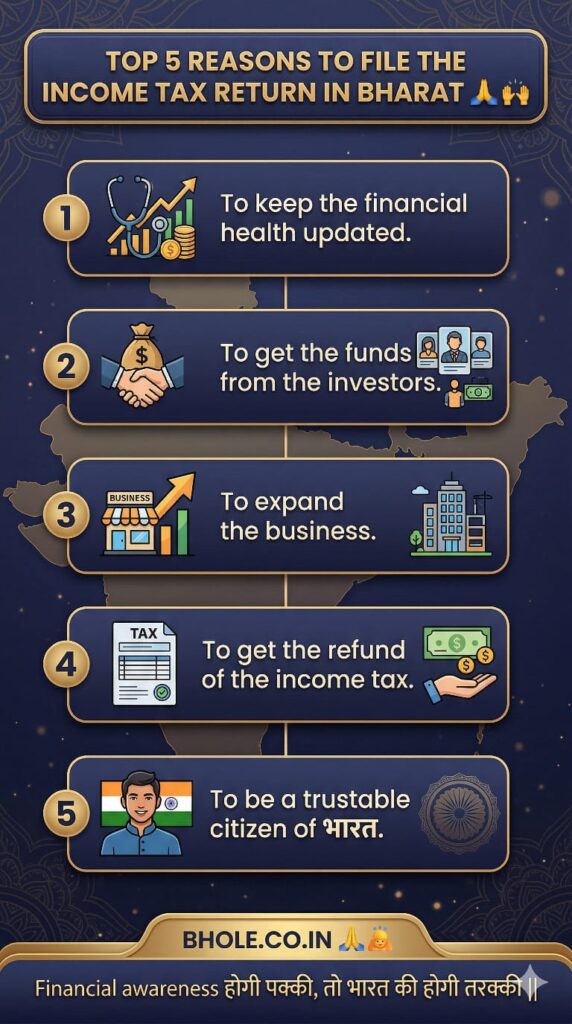
    1. The Ultimate “Financial Health” Check-up

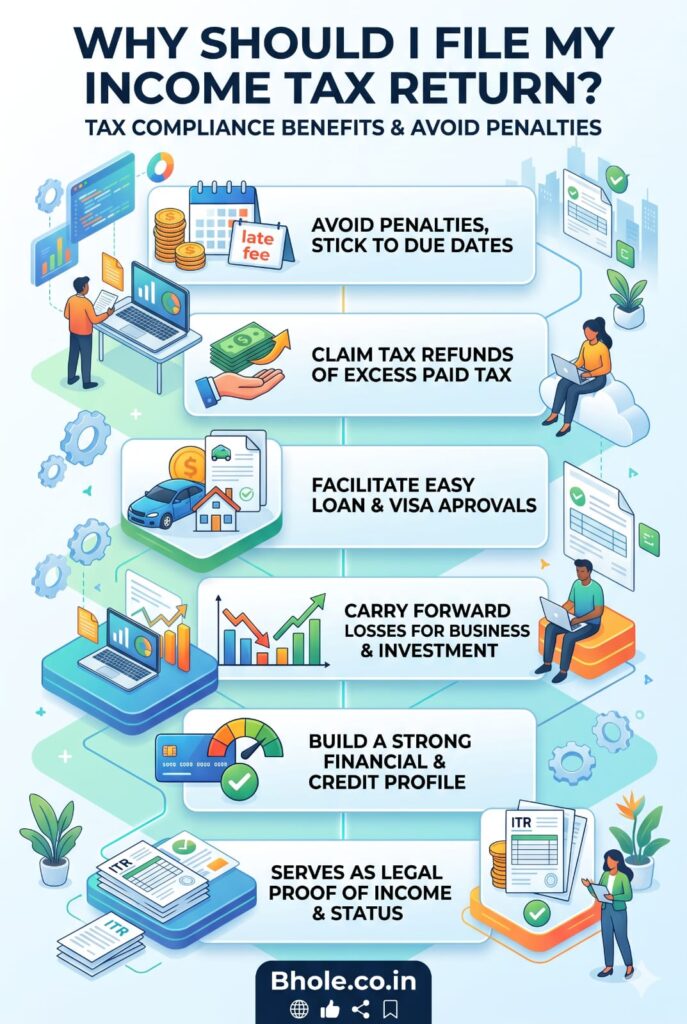
    Think of your ITR as a medical report for your money. Whether you are applying for a home loan, a car loan, or even a high-value insurance policy, banks and institutions look at your ITR history first. It proves your earning capacity and makes you a “low-risk” candidate in the eyes of lenders.

    2. A Magnet for Investors

    If you are an entrepreneur or a startup founder, transparency is your best currency. No serious investor will put money into a business that doesn’t have its tax records in order. Clean ITRs show that you are disciplined, organized, and ready for professional scaling.

    3. Fuel for Business Expansion

    Scaling a business requires capital. To get business loans or credit lines, a consistent track record of ITR filing is mandatory. It acts as the primary document to verify your business’s turnover and profitability over the years.

    4. Claim What is Rightfully Yours (Refunds!)

    Sometimes, the tax deducted at source (TDS) is higher than your actual tax liability. If you donโ€™t file your return, that extra money stays with the government forever. Filing your ITR is the only way to get that refund back into your bank account. Itโ€™s like finding forgotten money in an old pair of jeansโ€”except it’s legal and documented!

    5. The Badge of a Trustable Citizen

    At its core, filing ITR is a contribution to nation-building. It establishes you as a law-abiding, responsible, and trustable citizen of Bharat ๐Ÿ™๐Ÿ™‡. It also simplifies legal processes, such as visa applications, where most embassies require 3 years of ITR as proof of your ties to your home country.


    ๐Ÿ’ก The Bottom Line

    As the tagline says:

    Financial awareness เคนเฅ‹เค—เฅ€ เคชเค•เฅเค•เฅ€, เคคเฅ‹ เคญเคพเคฐเคค เค•เฅ€ เคนเฅ‹เค—เฅ€ เคคเคฐเค•เฅเค•เฅ€ |

    Filing your taxes isn’t just about “giving”; it’s about “building”โ€”building your credit, building your business, and building the nation.

  • Optimizing the Way of Doing Business: A Blueprint for Modern Success

    In todayโ€™s hyper-competitive market, survival isn’t just about how hard you work; itโ€™s about how smartly you operate. The traditional paradigms of commerce are shifting, and the most successful enterprises are those that constantly ask themselves: Are we truly optimizing the way we do business?

    At BHOLE ๐Ÿ™๐Ÿ™‡(Business Hours Optimizers & Legal Experts) ๐Ÿ™๐Ÿ™‡, we believe that optimization is not just a buzzwordโ€”it is the very foundation of sustainable growth and long-term success. True business optimization is a multi-faceted approach that transforms raw effort into targeted, profitable results.

    Here is what it means to truly optimize your business operations from the ground up:

    1. Making Every Second Count

    Time is the only non-renewable resource in business. As the gears and clocks of industry keep turning, optimizing your business hours means streamlining workflows, eliminating bottlenecks, and automating repetitive tasks. Itโ€™s about ensuring that your team’s energy is spent on high-value, strategic initiatives rather than getting bogged down in administrative friction. When you optimize your time, you accelerate your output.

    2. Building on a Foundation of Compliance

    You cannot scale a business on shaky ground. Just as heavy construction equipment lays the groundwork for towering skyscrapers, robust legal frameworks protect and support your business ambitions. Navigating corporate law, contracts, and regulatory compliance is complex. By integrating expert legal guidance into your daily operations, you mitigate risks before they arise, ensuring that your upward trajectory is safe, secure, and built to last.

    3. Engineering Financial Growth

    Ultimately, optimization must reflect in the bottom line. Whether it’s through restructuring tax strategies, reducing operational waste, or identifying new avenues for revenue, every optimized process should lead to greater financial health. It is about turning operational efficiency into measurable profitability.

    The BHOLE ๐Ÿ™๐Ÿ™‡ Advantage

    Optimizing a business requires a dual lens: the operational vision to maximize productivity and the legal acumen to protect your assets. You need a strategy that propels you forward while keeping you securely anchored in compliance.

    It’s time to stop just “doing business” and start optimizing it. By refining your processes, protecting your intellectual and physical assets, and focusing on sustainable financial strategies, you pave the way for unprecedented growth.

  • The BHOLE ๐Ÿ™๐Ÿ™‡ Methodology

    Our approach is a disciplined, four-phase journey that ensures our solutions are insightful, customized, and sustainable. This methodology is the practical application of our core philosophy.

    Phase 1: Discover & Diagnose
    (The Application of Dhyan ๐Ÿ™๐Ÿ™‡)
    This initial phase is an intensive immersion into your business. We conduct stakeholder interviews, process observations, and data analysis. With deep focus, we listen and learn, ensuring we understand not just what you do, but why you do it the way you do. The output is a comprehensive diagnostic report detailing strengths, weaknesses, and opportunities.

    Phase 2: Design & Develop
    (The Application of Gyan ๐Ÿ™๐Ÿ™‡)
    Armed with insights, we enter the design phase. Leveraging our extensive knowledge of best practices and innovative strategies, we develop a bespoke optimization plan. This is not a one-size-fits-all template; it is a detailed, actionable blueprint tailored to your specific goals, culture, and resources.

    Phase 3: Deploy & Deliver
    (The Application of Shri SitaRam ๐Ÿ™๐Ÿ™‡)
    This is where strategy becomes action. We work hand-in-hand with your team to implement the proposed changes. Our role is that of a dedicated partner, providing guidance, training, and support to ensure a smooth transition. We manage the project with sincere commitment, overcoming challenges and driving toward the agreed-upon objectives.

    Phase 4: Drive & Dedicate ๐Ÿ™๐Ÿ™‡
    (Sustaining the Commitment)
    Our engagement doesn’t end at delivery. We believe in building lasting capabilities. In this final phase, we establish monitoring systems, help you track key performance indicators, and ensure your team is fully equipped to sustain the improvements independently. We remain dedicated to your long-term success, offering ongoing support as you continue to evolve.

  • The Awakening of Bharat ๐Ÿ™๐Ÿ™‡: How Financial Awareness is the Blueprint for BHARATโ€™S ๐Ÿ™๐Ÿ™‡ Growth.

    When we talk about the economic rise of our nation, the conversation often centers around towering skyscrapers, booming tech hubs, and corporate milestones. But the true engine of BHARATโ€™S future does not just lie in its metropolitan cities; it beats in the heart of Bharat ๐Ÿ™๐Ÿ™‡โ€”our vast network of villages, towns, and grassroots communities.

    Today, Bharat ๐Ÿ™๐Ÿ™‡ is experiencing an unprecedented digital revolution. Smartphones are everywhere, and the world looks at our UPI (Unified Payments Interface) system with awe. However, digital access is only half the battle. To truly unlock the superpower of our nation, we need the other half: Deep Financial Awareness.

    Here is how transforming financial literacy in Bharat ๐Ÿ™๐Ÿ™‡ will fundamentally change the growth trajectory of our country.

    1. Breaking the Debt Trap and Fostering Capital Creation.

    For generations, a lack of financial literacy has left many in rural and semi-urban areas vulnerable to informal money lenders and exorbitant interest rates. Financial awareness changes this narrative.

    From Saving to Investing: When people understand the difference between letting money sit idle and investing it (through mutual funds, government bonds, or fixed deposits), dormant savings turn into active capital.

    Capital Formation: This newly active capital flows into the formal banking system, giving banks more power to lend to businesses and infrastructure projects, accelerating national growth.

    2. Empowering the Backbone: MSMEs and Agriculture.

    Micro, Small, and Medium Enterprises (MSMEs) and agriculture are the lifeblood of Bharat ๐Ÿ™๐Ÿ™‡.

    Smarter Scaling: When local entrepreneurs and farmers understand financial tools like credit scores, micro-insurance, and government subsidies, they can scale their operations safely.

    Risk Mitigation: Crop insurance and business safety nets ensure that a single bad monsoon or market dip does not wipe out a family’s livelihood, creating a resilient local economy.

    3. The Multiplier Effect of Women’s Financial Inclusion.

    There is a well-known economic truth: when you financially empower a woman, you uplift an entire family.

    Financial awareness gives women in Bharat ๐Ÿ™๐Ÿ™‡ the confidence to take charge of household budgets, start small enterprises, and invest in their children’s education.

    Bringing millions of women into the formal financial workforce will dramatically increase the country’s GDP and create a more equitable society.

    4. Transitioning from Cash to a Formal Economy.

    While UPI has made digital payments a daily habit, true financial awareness means understanding taxation, invoicing, and formal bookkeeping. As local businesses in Bharat ๐Ÿ™๐Ÿ™‡ recognize the long-term benefits of operating within the formal economy (such as easier access to large-scale business loans), the nation’s tax base widens. This gives the government more resources to build better roads, schools, and hospitals back into those very communities.

    5. Creating a Culture of Wealth Generation.

    Financial awareness shifts the mindset from mere survival to actual wealth generation. It teaches the power of compounding. When a young person in a tier-3 town starts investing even a tiny amount systematically, they are building generational wealth. A country made up of financially secure citizens is fundamentally more stable, innovative, and powerful.

    The Path Forward
    The infrastructure is already laid. Initiatives like the Jan Dhan Yojana have given Bharat ๐Ÿ™๐Ÿ™‡ bank accounts, and mobile internet has given them connectivity. The next great national movement must be an educational one.

    We need to simplify financial jargon, deliver financial education in regional languages, and make investment concepts as accessible as a WhatsApp forward.

    When Bharat ๐Ÿ™๐Ÿ™‡ understands the power of its own money, there is no limit to what we can achieve. The growth will not just be faster; it will be deeper, fairer, and unstoppable.

  • Our Guiding Philosophy ๐Ÿ™๐Ÿ™‡ and Interpretation of Dhyan ๐Ÿ™๐Ÿ™‡l Gyan ๐Ÿ™๐Ÿ™‡ l Shri SitaRam ๐Ÿ™๐Ÿ™‡

    At the heart of BHOLE ๐Ÿ™๐Ÿ™‡ | Business Hours Optimizers & Legal Experts ๐Ÿ™๐Ÿ™‡ lies a timeless and profound ethical framework that guides our every action and decision. This philosophy, Dhyan ๐Ÿ™๐Ÿ™‡ | Gyan ๐Ÿ™๐Ÿ™‡ | Shri SitaRam ๐Ÿ™๐Ÿ™‡ is not just a set of principles; it is our operational and spiritual compass.

    Dhyan | เคงเฅเคฏเคพเคจ – The Power of Focus ๐Ÿ™๐Ÿ™‡

    Dhyan is the principle of complete and unwavering focus. When we engage with a client’s challenges, we do so with meditative concentration. We immerse ourselves in their world, listen with intent, and observe with precision. This allows us to see beyond the surface-level symptoms and identify the root causes of inefficiency. Our focus is our promise to give your business the undivided attention it deserves.

    Gyan | เคœเฅเคžเคพเคจ – The Pursuit of Knowledge ๐Ÿ™๐Ÿ™‡

    Gyan represents the continuous development and application of knowledge. The business landscape is ever-evolving, and so are we. We are committed to perpetual learning, staying at the forefront of industry best practices, technological advancements, and strategic innovations. This ever-expanding base of knowledge ensures that our solutions are not just effective today, but are also robust and forward-thinking.

    Shri SitaRam | เคถเฅเคฐเฅ€ เคธเฅ€เคคเคพเคฐเคพเคฎ – The Spirit of Sincere Commitment ๐Ÿ™๐Ÿ™‡

    This principle is the culmination of our ethos. It represents our sacred commitment to you, our client. Shri SitaRam ๐Ÿ™๐Ÿ™‡ is the promise to channel all our focus (Dhyan) ๐Ÿ™๐Ÿ™‡ and all our knowledge (Gyan) ๐Ÿ™๐Ÿ™‡ into our work. It is the pledge to put forth our absolute best efforts with the utmost sincerity and integrity, treating the optimization of your business as our most important duty. It is through this devoted service that we aim to deliver exceptional value.

  • Full form of BHOLE ๐Ÿ™๐Ÿ™‡

    BHOLE ๐Ÿ™๐Ÿ™‡ is a premier business consulting firm dedicated to a singular, powerful objective: to optimize the way businesses operate. In a world of constant change and competition, efficiency is not just an advantage; it is a necessity. We partner with organizations to meticulously analyze, refine, and transform their processes, ensuring they achieve superior results with the most optimized efforts. Our approach is holistic, blending strategic insight with practical, on-the-ground implementation. We are “Business Hours Optimizers & Legal Experts,” ๐Ÿ™๐Ÿ™‡ a title that reflects our dual proficiency in enhancing operational workflow while ensuring a robust and compliant strategic foundation.